Every star starts as a cold cloud and ends as something stranger. Pick a chapter. Where scientists disagree on a number, you'll see the range, not a single figure.
Before there could be stars there had to be a universe cool enough to make them. Here is the journey from the Big Bang to the Sun, and on to the far future.
An illustration, not a simulation. Ages come from measurements of the cosmic microwave background and of distant galaxies; early-universe times are model-based and rounded.
The universe as one calendar year
Squeeze 13.8 billion years into one year, starting at midnight on 1 January. The Sun forms around 31 August. All of recorded human history fits into roughly the last 11 seconds of 31 December.
How we know
The oldest light
The cosmic microwave background is light released 380,000 years after the Big Bang. Satellites such as COBE, WMAP and Planck mapped its tiny ripples, which give the universe's age and contents.
Looking back in time
Light from far away left its source long ago. Webb's infrared camera catches galaxies whose light set out when the universe was only a few hundred million years old.
The first elements
The amount of hydrogen, helium and lithium in the oldest gas matches what Big Bang physics predicts for the first few minutes.
Expansion
Distant galaxies are moving away from us, the farther the faster. Run that backwards and everything meets at a single hot, dense start.
Stars form inside nebulae: huge, cold clouds of gas and dust. Gravity pulls a dense clump together until its centre gets hot enough to fuse hydrogen, and the leftovers become planets. Step through it below, ending with our own Solar System.
An illustration, not a simulation: particle motions are schematic. Timescales are typical values for a Sun-like star; heavier stars move through these stages much faster. Planet sizes and orbits are not to scale.
Seen by telescopes
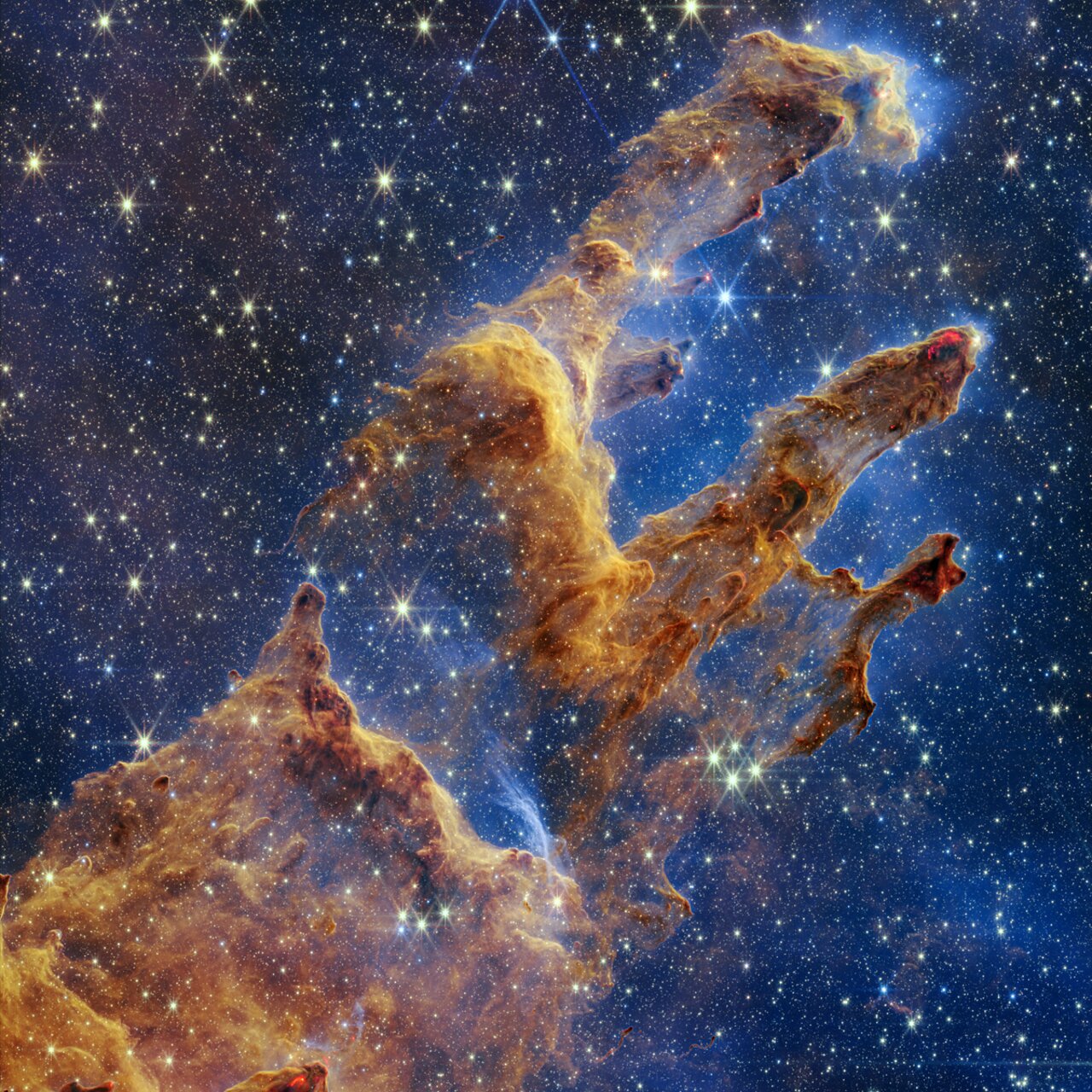
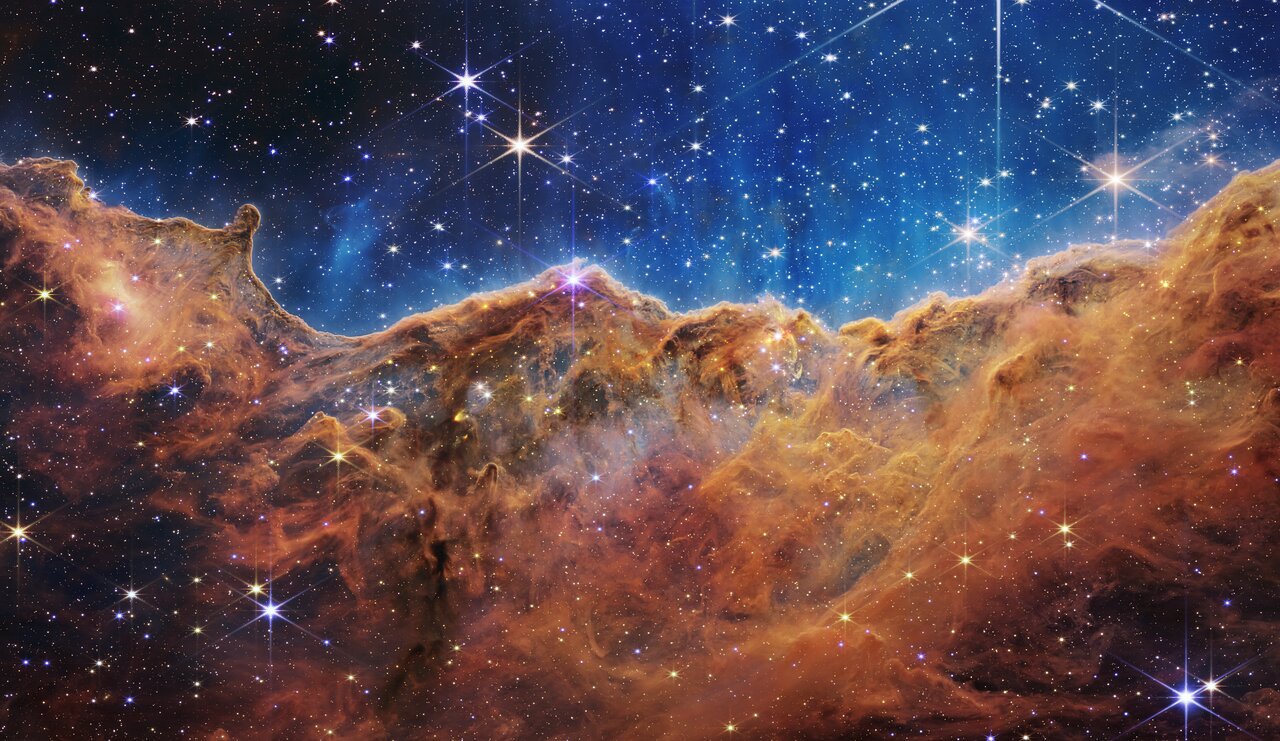
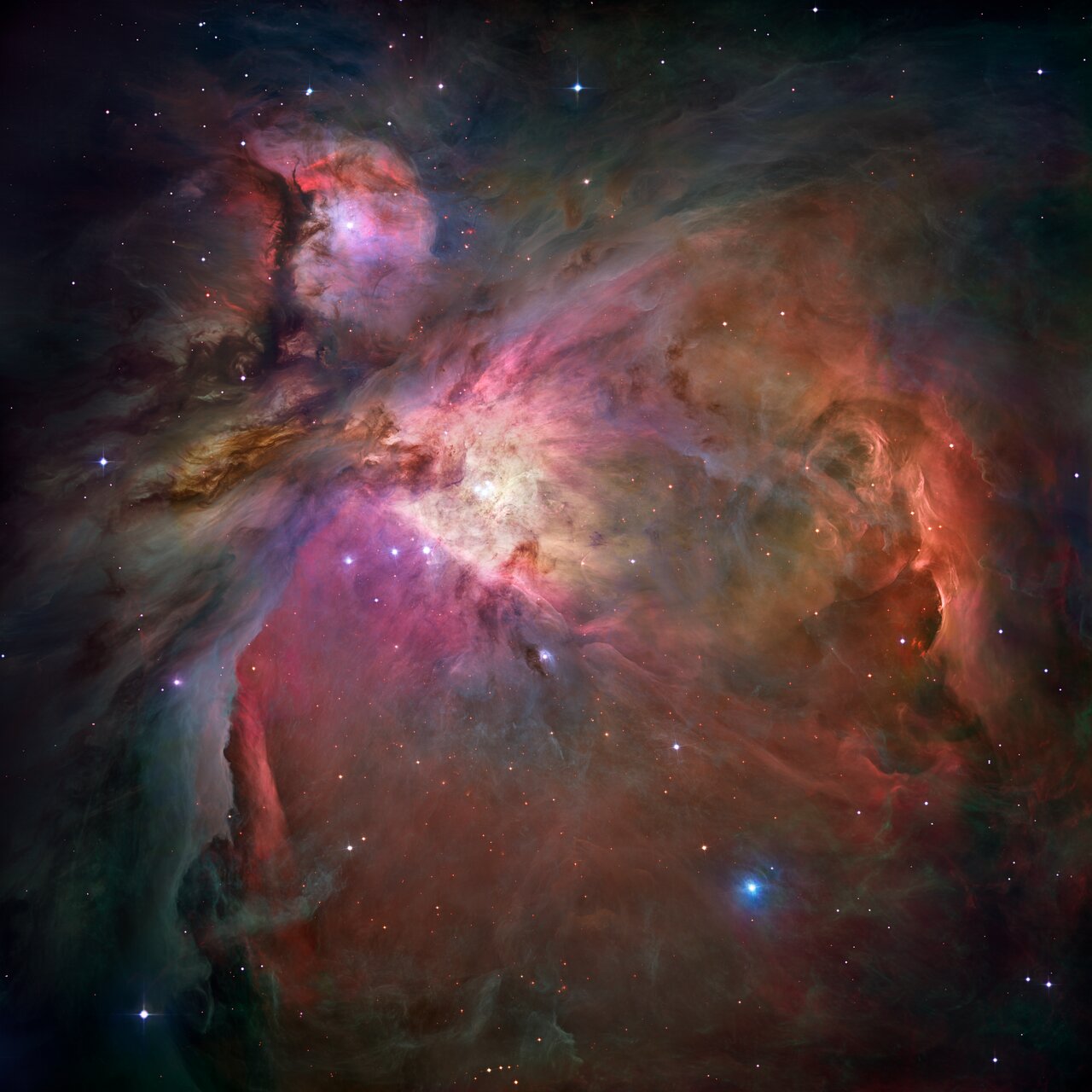
Real image · Webb · infrared, colours assignedThe Pillars of Creation in the Eagle Nebula. Each pillar is a cold column of gas and dust, and new stars are forming inside the tips.NASA, ESA, CSA, STScI; J. DePasquale, A. Koekemoer, A. Pagan (STScI) · CC BY 4.0Real image · Webb · infrared, colours assignedThe "Cosmic Cliffs" in NGC 3324, part of the Carina Nebula, about 7,600 light years away. Infrared light passes through dust, so Webb sees young stars that visible light can't.NASA, ESA, CSA, and STScI · CC BY 4.0Real image · HubbleThe Orion Nebula, the nearest large star nursery, roughly 1,300–1,400 light years away. This Hubble mosaic shows thousands of young stars, many still wrapped in the disks where planets form.NASA, ESA, M. Robberto (STScI/ESA) and the Hubble Space Telescope Orion Treasury Project Team · CC BY 4.0
Kinds of nebula where stars are born
Emission nebula
e.g. Orion, Carina
Gas lit up from inside by hot young stars. Their ultraviolet light strips electrons off hydrogen atoms, which then glow red as they recapture them.
Dark nebula
e.g. the Pillars, Horsehead
Dust so thick it blocks the light behind it. These cold, dense patches are where collapse actually begins.
Reflection nebula
e.g. the haze around the Pleiades
Dust that doesn't glow itself but scatters nearby starlight. It looks blue for the same reason our sky does.
Planetary nebulae and supernova remnants are a different thing: they're made by dying stars, not newborn ones. They belong in the Death chapter.
How we know
Infrared sees through dust
Visible light is blocked by dust; longer infrared waves get through. That's why Webb and Spitzer can watch protostars that look like dark blobs to Hubble.
Many snapshots, one story
No one can watch a star form, because it takes millions of years. Astronomers piece the sequence together from thousands of stars caught at different ages, like learning how trees grow from one walk through a forest.
A star's whole life is decided mostly by one number: its mass. Choose a Sun-like star or a massive one and follow it from cloud to remnant.
An illustration, not to scale in time: the steady middle stage takes up almost all of a star's life but gets one step here. Sizes are drawn so you can see them, not to exact scale.
Two endings
Stars like the Sun
Steady life
about 10 billion years
Swells to
red giant, ~100–200× wider
Sheds
its outer layers as a planetary nebula
Leaves
a white dwarf about Earth's size
Stars over about 8 Suns
Steady life
a few to tens of millions of years
Swells to
red supergiant
Ends in
a core-collapse supernova
Leaves
a neutron star or, for the heaviest, a black hole
How we know
Star clusters are snapshots
All the stars in a cluster were born at about the same time but with different masses. Heavy ones age faster, so one cluster shows several life stages side by side.
We have watched a star explode
In 1987 a supernova went off in the Large Magellanic Cloud. Detectors on Earth caught a burst of neutrinos from its collapsing core hours before the light arrived, just as theory predicted.
The biggest stars known are red supergiants and hypergiants. Put one where the Sun is and its surface would reach past Mars, some past Jupiter. But their sizes are hard to measure, so each one is shown as a range.
star, best estimaterange of estimatesplanet orbits
Scale drawing. 1 AU, the Earth–Sun distance, is about 215 times the Sun's radius. The Sun itself is a dot too small to see at this scale.
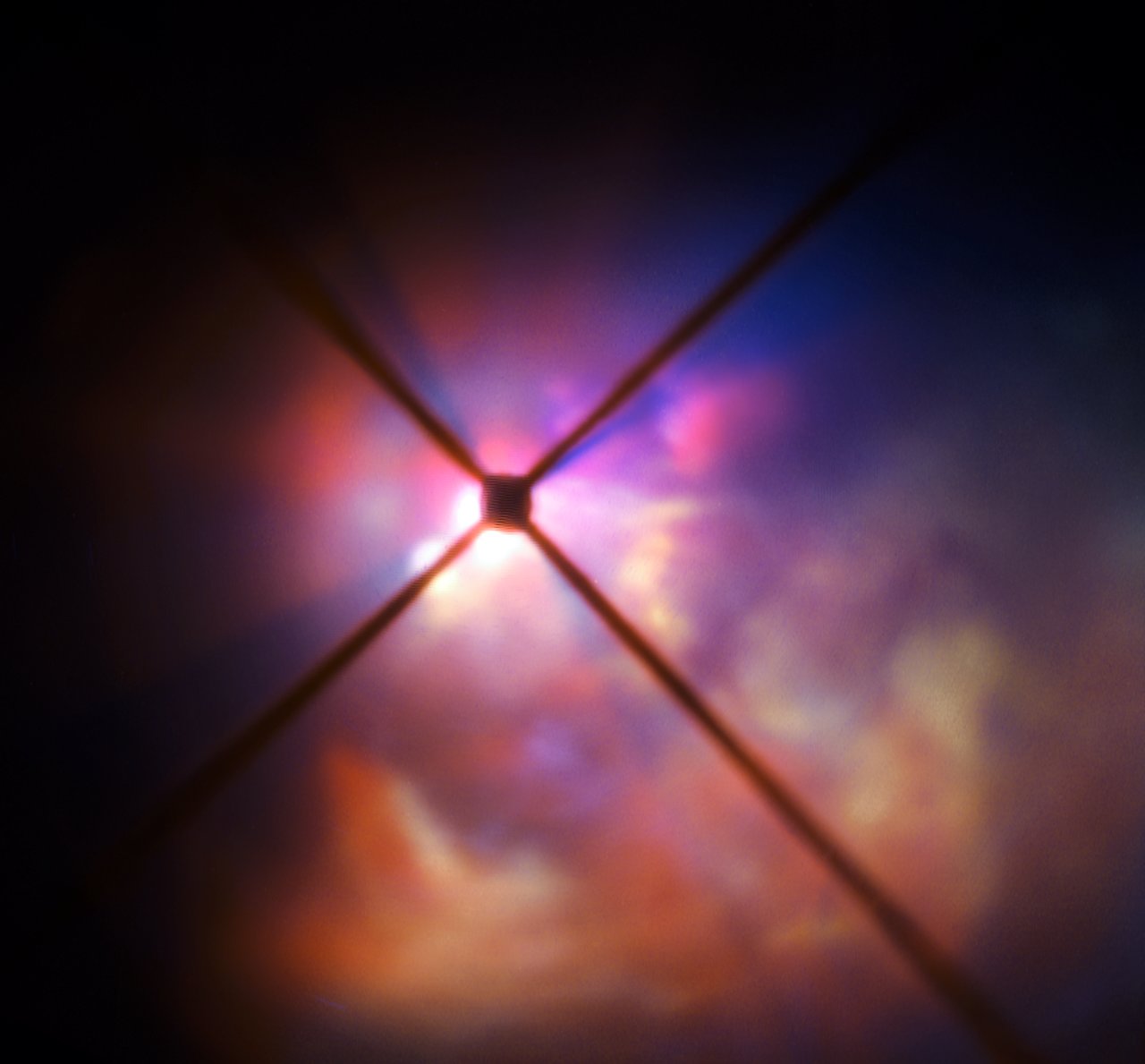
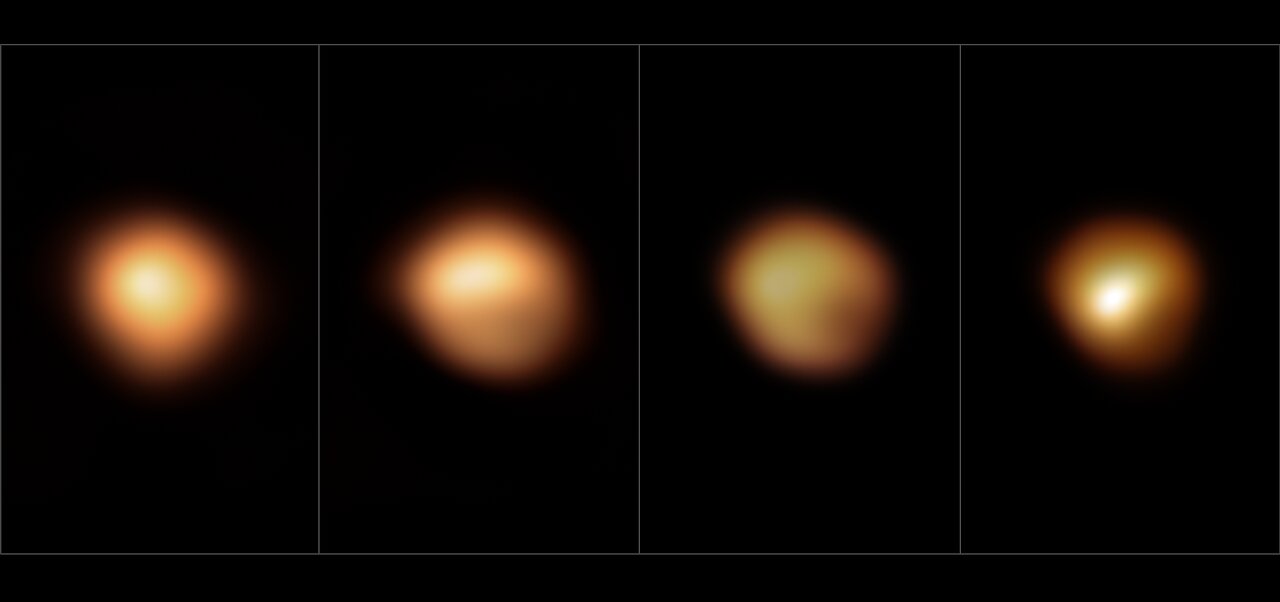
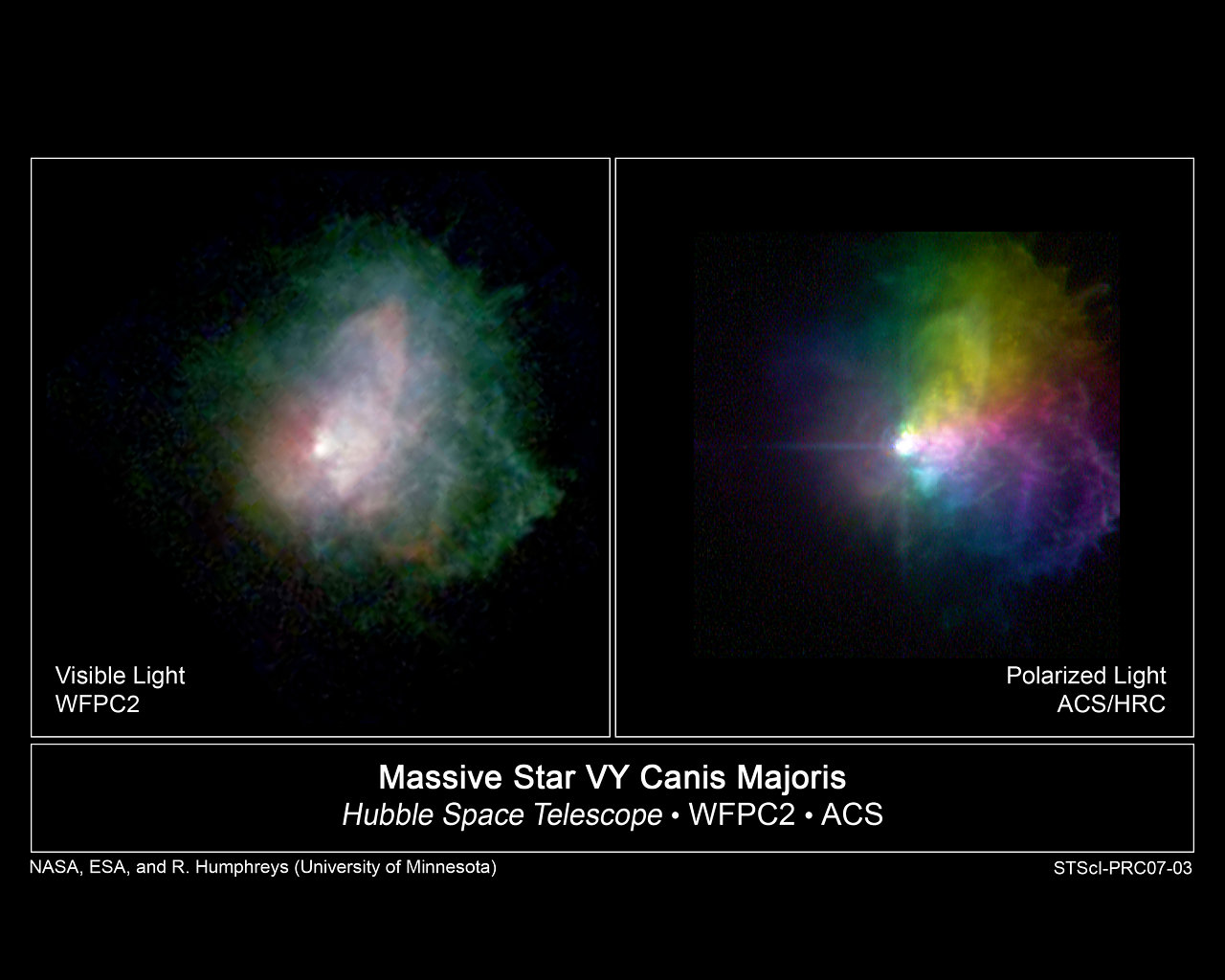
Real image · ESO VLT · SPHEREThe surroundings of VY Canis Majoris. The star itself is hidden behind a mask at the centre; what you see is its light reflecting off clouds of dust it has thrown off. The cross-shaped marks are from the instrument.ESO · CC BY 4.0Real image · ESO VLT · SPHEREBetelgeuse's surface in January 2019, then December 2019, January 2020 and March 2020, during its "Great Dimming". The study concluded a cloud of dust had partly hidden the star. It was back to normal by April 2020.ESO/M. Montargès et al. · CC BY 4.0
VY Canis Majoris, the way scientists see it
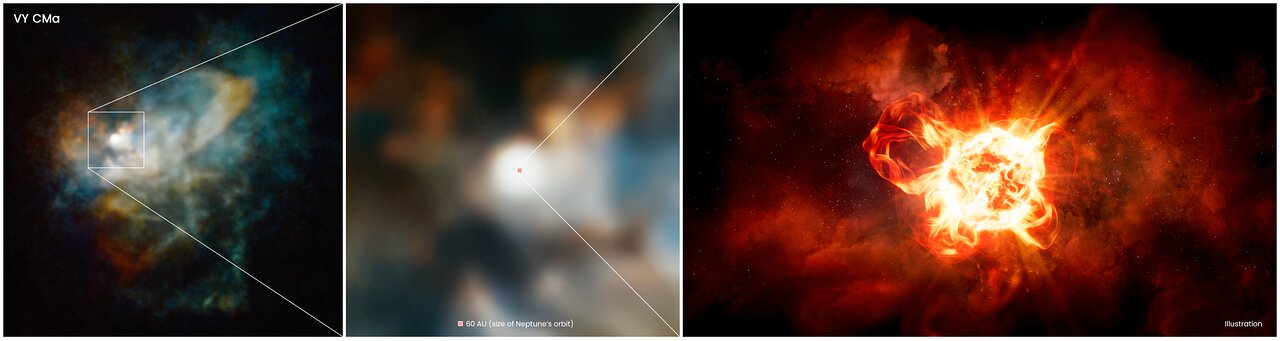
Real image · HubbleThe cloud VY Canis Majoris has thrown off. Measured six years apart, the arcs and knots move at different speeds in different directions, so they came from separate outbursts. One bright arc is racing out at about 165,000 km/h and left the star roughly 500 years ago.NASA/ESA and R. Humphreys (University of Minnesota) · CC BY 4.0Hubble images, then an artist's impression (right panel)A zoom from the nebula, about 300 billion km across, to the knots near the star. The last panel is an illustration, not a photo. Hubble found its outbursts go back more than 1,000 years and line up with times the star faded, like Betelgeuse's Great Dimming but bigger.NASA, ESA, R. Humphreys (University of Minnesota), J. Olmsted (STScI) · CC BY 4.0
What its fate may be
VY Canis Majoris may already have shed around half its mass. It could end as a supernova and leave a neutron star, or collapse straight into a black hole. Nobody knows which, or when.
Why its size is debated
The star sits inside its own dust cloud, which blurs where its surface ends, and its distance is not known precisely. That is why older estimates ranged from about 600 to over 3,000 times the Sun's radius.
Why the sizes disagree
Distance first
We usually get a star's size from how bright it is and how far away it is. For distant supergiants the distance is uncertain, and every error in distance becomes an error in size. That's why UY Scuti's estimate dropped from about 1,700 to 755 Suns when a new distance came out.
No sharp edge
These stars are puffy, blotchy and losing gas. Their "surface" fades out gradually, so measured size depends on the wavelength of light used.
Biggest isn't heaviest
R136a1 is around 200 times the Sun's mass, the most massive star known, but only about 40 times its width. The biggest stars are swollen near the end of their lives, not the heaviest ones.
Lists keep changing
The "largest star" title has changed hands many times. Treat any single number on this page as today's best estimate, not a final answer.
How a star dies depends mostly on how heavy it was at birth. Slide to choose a star's starting mass and see what it leaves behind. Every ending gives material back to space, and that material goes into new stars, planets and people.
0.11 (Sun)825100
The boundaries are approximate. Around 8 Suns separates white dwarfs from supernovae; whether a supernova leaves a neutron star or a black hole depends on more than mass alone, so that line, very roughly 20–25 Suns, is fuzzy.
Seen by telescopes
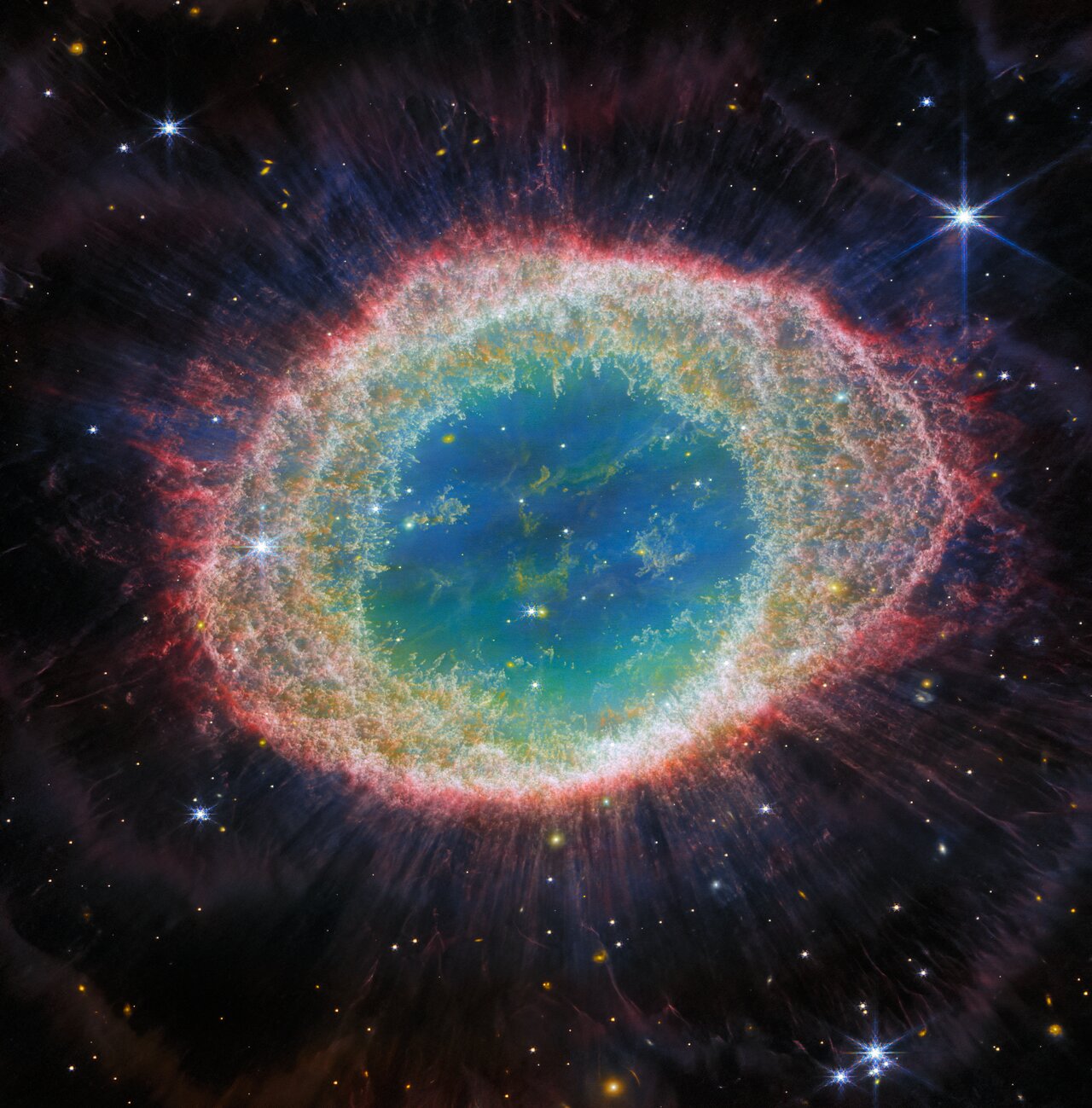
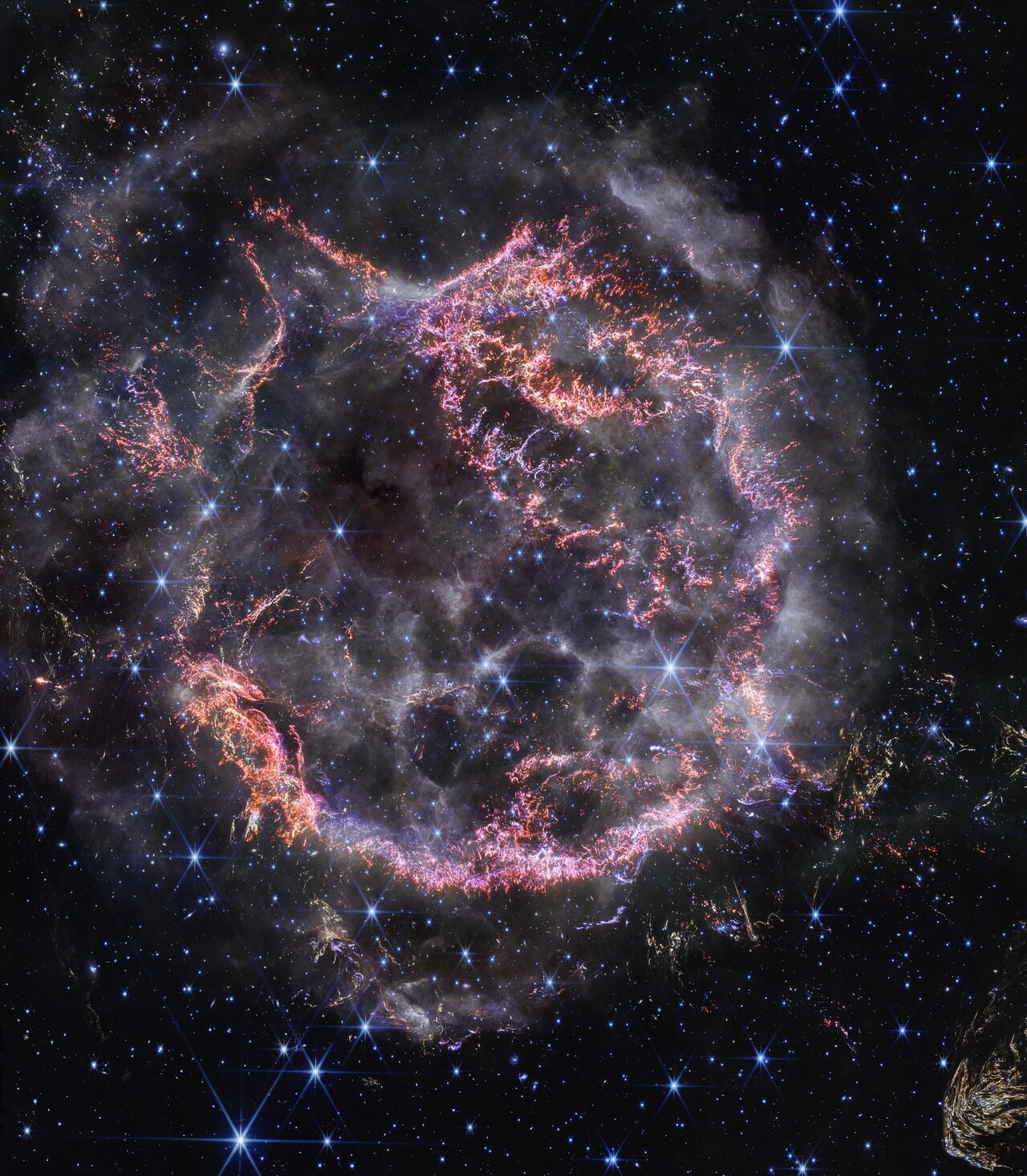
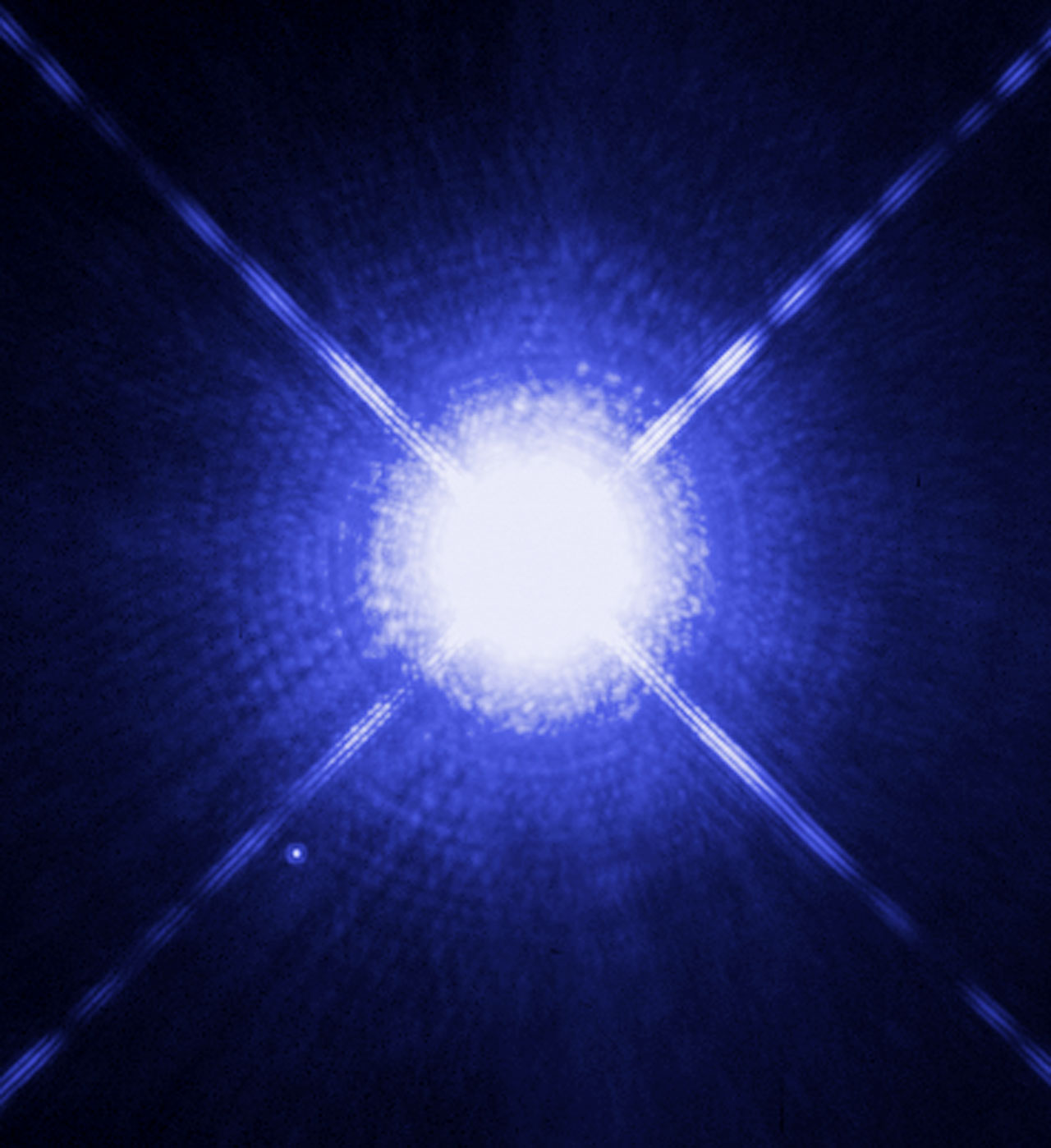
Real image · Webb · infrared, colours assignedThe Ring Nebula, about 2,500 light years away: a Sun-like star's outer layers, thrown off and lit by the hot core left in the middle. This is roughly the Sun's future.ESA/Webb, NASA, CSA, M. Barlow, N. Cox, R. Wesson · CC BY 4.0Real image · Webb · infrared, colours assignedCassiopeia A, the debris of a massive star whose explosion would have been visible from Earth about 340 years ago. It is about 11,000 light years away and 10 light years across.NASA, ESA, CSA, STScI, D. Milisavljevic (Purdue University), T. Temim (Princeton University), I. De Looze (University of Gent) · CC BY 4.0Real image · HubbleSirius and, at lower left, the tiny dot of Sirius B, the nearest white dwarf at 8.6 light years. It is about 12,000 km across, smaller than Earth, yet holds 98% of the Sun's mass. The spikes and rings are made by the telescope.NASA, ESA, H. Bond (STScI), and M. Barstow (University of Leicester) · CC BY 4.0
We are made of dead stars
Carbon and nitrogen
Much of the carbon in your body and the nitrogen in the air were made inside Sun-like stars and blown out as they died.
Oxygen, calcium, iron
Massive stars build these in their cores and scatter them when they explode as supernovae.
Gold and platinum
Many of the heaviest elements are thought to come from collisions of neutron stars, like the one caught by gravitational-wave detectors in 2017.
When a massive star's core collapses, it can leave a neutron star: more mass than the Sun packed into a ball about 23 km across, smaller than Hyderabad. Many spin many times a second and sweep beams across space like a lighthouse. When a beam crosses Earth, we see a pulse. That is a pulsar.
An illustration. The beams are drawn as cones from the magnetic poles, tilted from the spin axis; real beam shapes vary. "Hear it" plays one click per rotation at the real rate (sound only starts when you press it).
Nearby and famous pulsars
Pulsar
Distance
Spins per second
Why it matters
PSR J0437−4715
about 510 ly
174
The nearest and brightest millisecond pulsar. NICER measured its radius at about 11.4 km and its mass at 1.4 Suns. It keeps time better than atomic clocks.
RX J1856.5−3754
about 400 ly
about 1 every 7 s
One of the closest known neutron stars. It shines in X-rays from its hot surface rather than as a radio pulsar.
Geminga
about 800 ly
about 4
Seen mostly in gamma rays; almost silent in radio.
Vela pulsar
about 950 ly
about 11
Left by a supernova roughly 11,000 years ago. It sometimes suddenly speeds up, called a "glitch".
Crab pulsar
about 6,500 ly
about 30
Born in a supernova recorded by astronomers in 1054 CE. Its wind lights up the Crab Nebula.
PSR B1919+21
about 1,000 ly
about 0.75
The first pulsar ever found, by Jocelyn Bell Burnell in 1967.
Distances are rounded and some are uncertain. A full 3D map of nearby pulsars waits until we confirm the licence of the ATNF Pulsar Catalogue.
Seen by telescopes
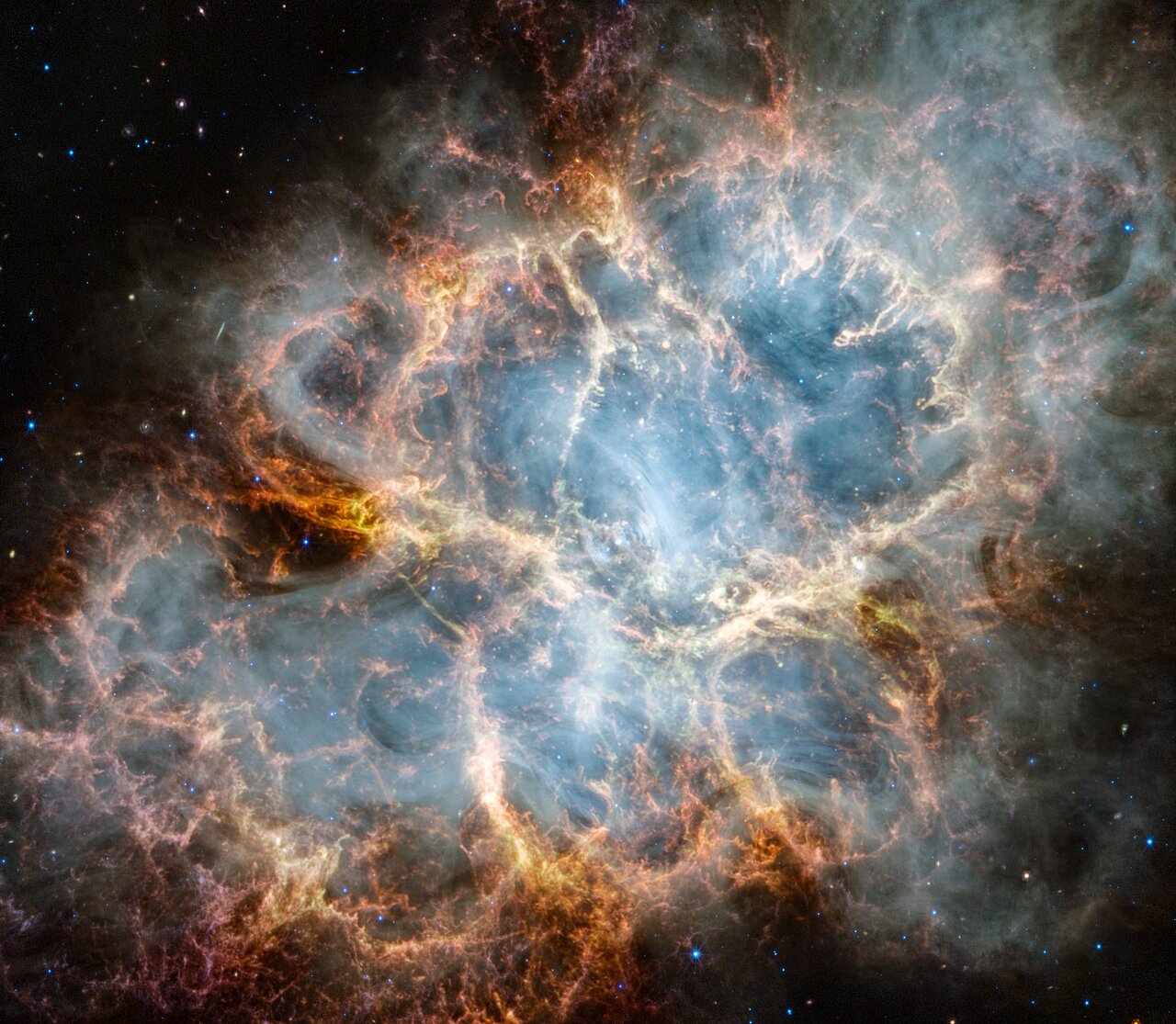
Real image · Webb · infrared, colours assignedThe Crab Nebula, the remains of the star that exploded in 1054. Follow the circular ripples in the middle to the bright dot: that is the pulsar, whose wind and magnetic field shape the glowing smoke-like interior.NASA, ESA, CSA, STScI, T. Temim (Princeton University) · CC BY 4.0
How scientists "see" a neutron star
No telescope can show one as a disc: it is far too small. Instead NICER, an X-ray telescope on the International Space Station, records how the pulses rise and fall. Because gravity bends light so strongly, the pulse shape gives away the star's size and the hot spots at its magnetic poles. For J0437 the spots turned out not to be exactly opposite each other.
Radio telescopes time pulses to within millionths of a second for years, which weighs the star and its companions. And in 2017 gravitational-wave detectors caught two neutron stars colliding.
How strange they are
Dense
A sugar-cube of neutron star material would weigh around a billion tonnes on Earth.
Fast
The fastest known pulsar spins 716 times a second. Its equator moves at a sizeable fraction of the speed of light.
Or a black hole
If the collapsing core is too heavy, nothing can stop it, and it becomes a black hole instead.
Sources
Images: ESA/Webb, ESA/Hubble and ESO, used under CC BY 4.0 with the credits shown on each image.
VY Canis Majoris: ESO release eso1546 and image eso1546a (description, 30–40 solar masses); radius about 1,420 ± 120 solar radii from Wittkowski et al. 2012.
VY Canis Majoris outflows: Humphreys et al., NASA/ESA Hubble releases opo0703 (2007) and opo2109 (2021).
Neutron stars: PSR J0437−4715 radius and mass from Choudhury et al. 2024 (ApJL 971, L20), NICER; other pulsar figures are rounded literature values.
Sirius B: ESA/Hubble release heic0516 (Barstow et al. 2005). Cassiopeia A: ESA/Webb release weic2330. Ring Nebula: ESA/Webb release weic2320. Mass boundaries for stellar endings are approximate textbook values.
Betelgeuse dimming: ESO release eso2109 (Montargès et al. 2021, Nature).
Other radii: published estimates summarised in the table, with the spread between studies shown as a range. Values are rounded.
Star formation and stellar life stages and timescales: standard textbook values, rounded.
Age of the universe, 13.8 billion years: Planck Collaboration 2018 results. Early galaxies: JWST Advanced Deep Extragalactic Survey (JADES) and later Webb programmes. Milky Way–Andromeda odds: Sawala et al. 2025, Nature Astronomy.